Optimisation and forecasting for manufacturing and supply chains
Optimal plans.Accurate forecasts.
PlanifAI searches millions of combinations for the plan that best meets your goals and your rules. And for each item it picks the forecasting model that best predicted your history.
- Runningin industry, energy and defence
- Two engines of our ownfor optimisation and forecasting
- Wherever you wantin the cloud, on your servers or offline
1,284,512 plans evaluated
Example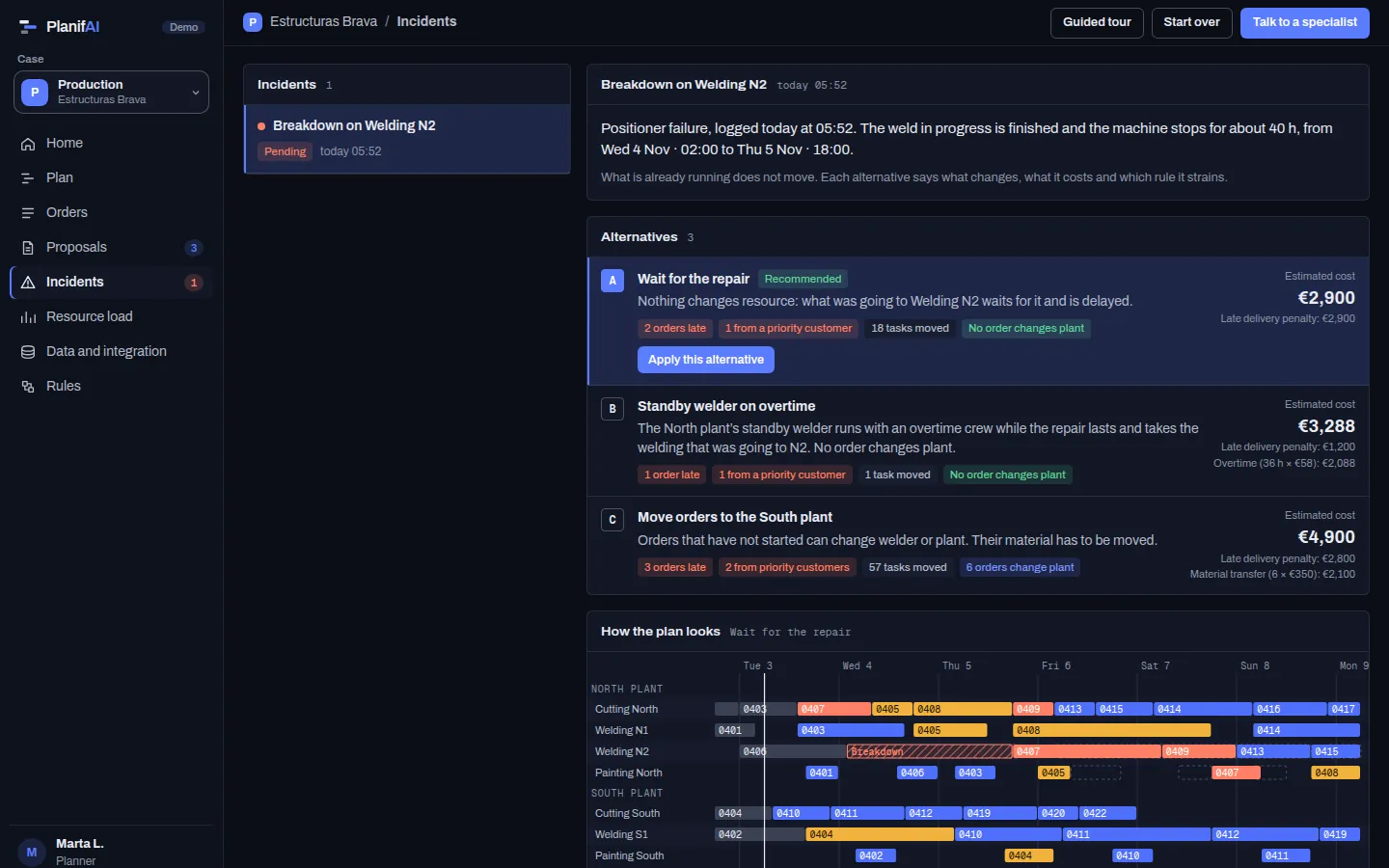
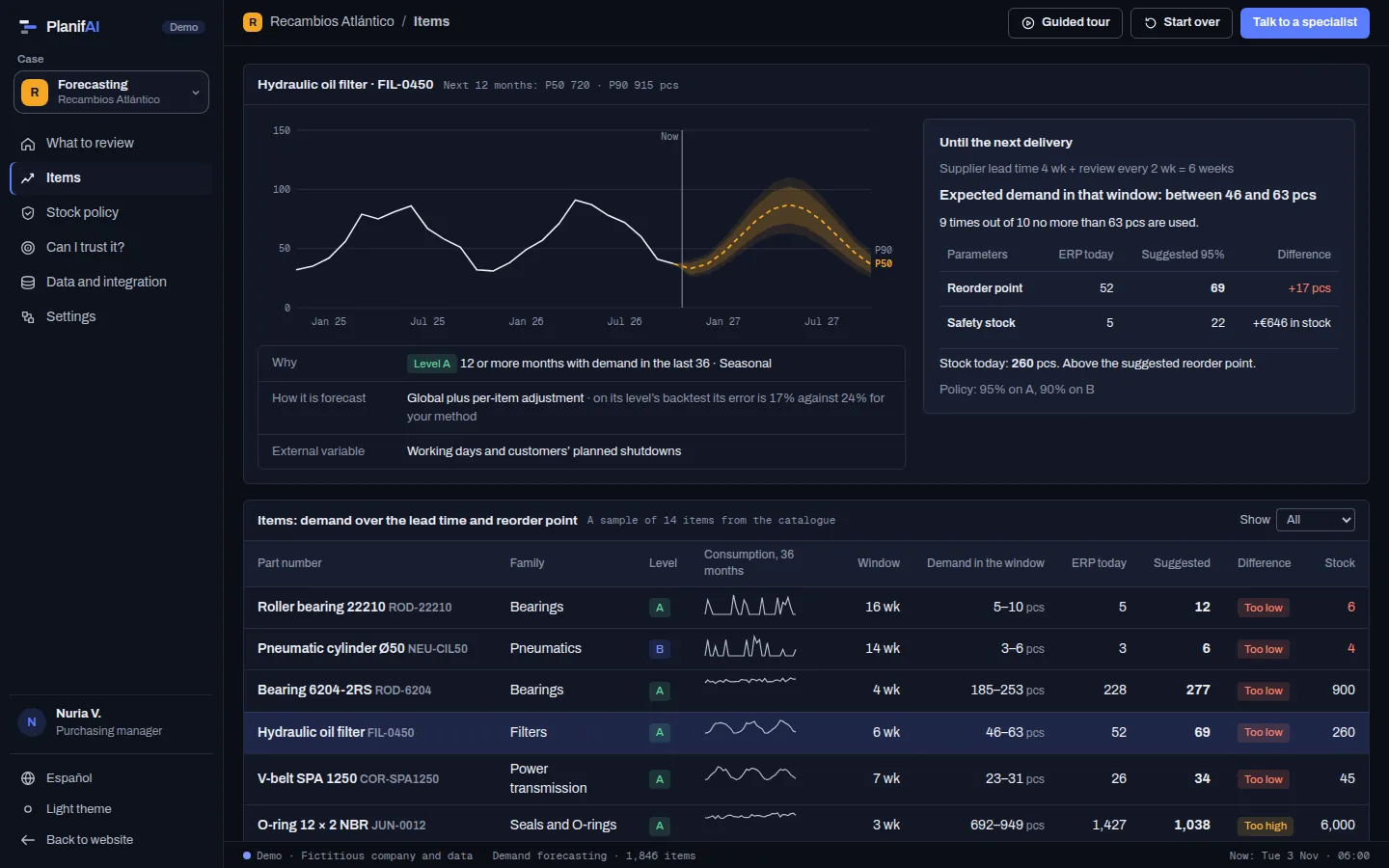
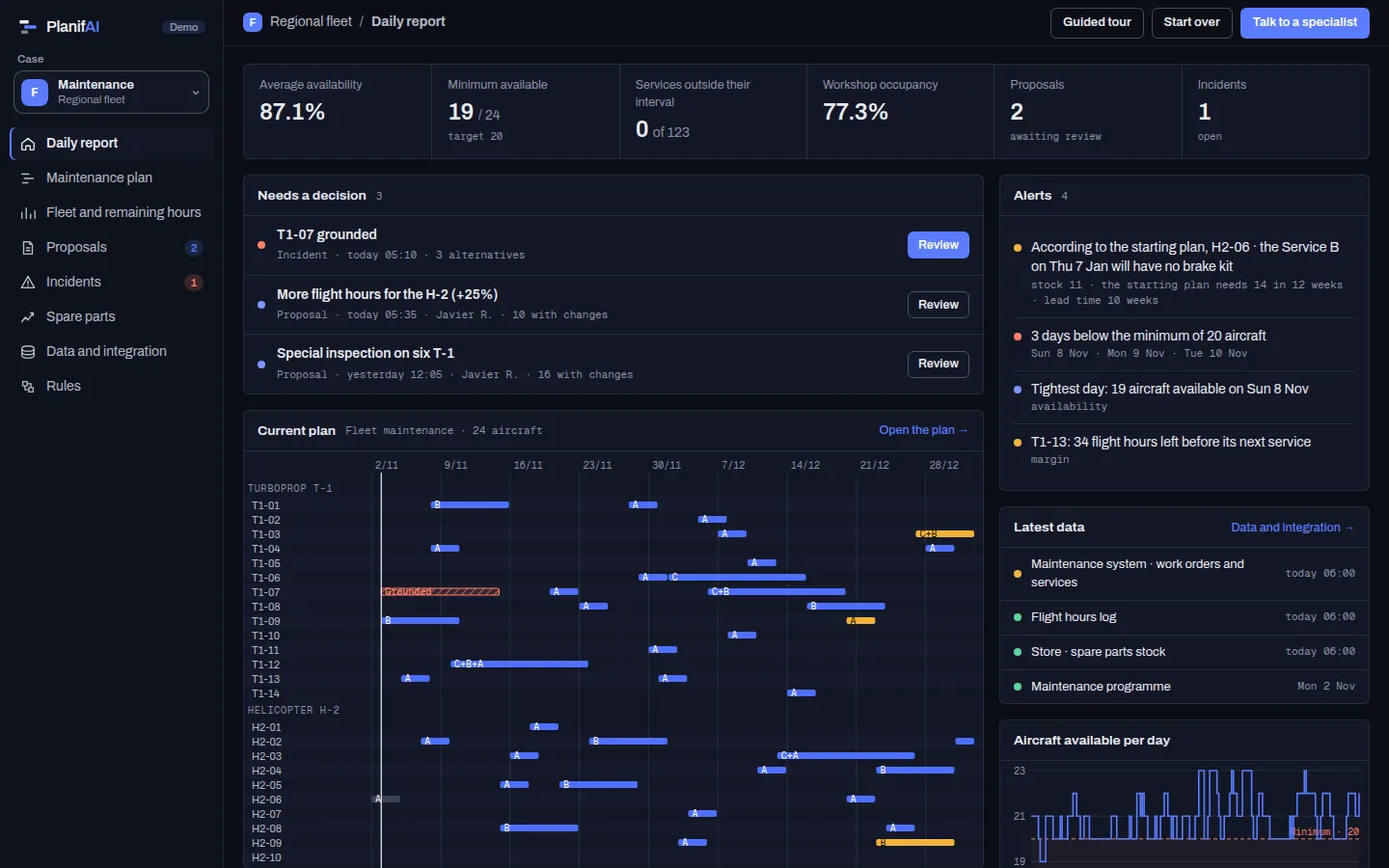
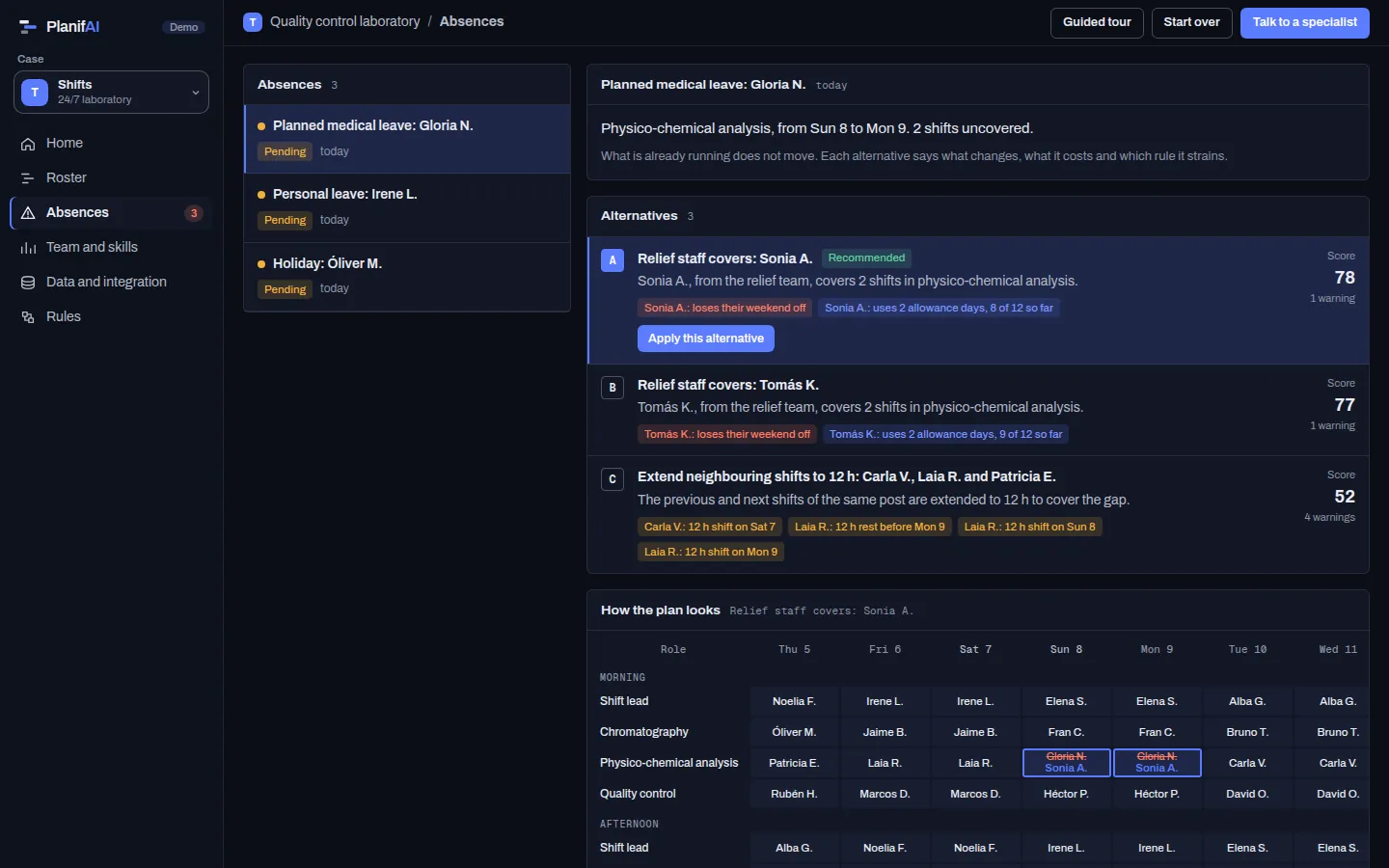
Demo screenshot · fictitious company and data
A plan that fits is not the best plan
2,432,902,008,176,640,0002,432,902,008,176,640,000ways to sequence just 20 orders on one machine. Add machines, shifts and plants, and the combinations do not fit in any spreadsheet.
By hand, you look for a plan that works and settle for it. Nobody ever sees the better ones.
You settle for the first one that fits
In a hurry and in a spreadsheet, the plan is whatever fits. Not the cheapest one, nor the one that meets the most dates.
One goal hides the others
Meeting dates pushes overtime up; saving overtime delays orders. Without seeing the trade-off, you decide blind.
One formula for the whole warehouse
The average of the last few months for every item: too much of the raw material you always use the same way, too few of the spare parts and components ordered in bursts.
Optimisation
Millions of plans evaluated. You keep the best.
The engine combines multi-objective evolutionary search with constraint programming: it respects all your rules and finds the best trade-off between your goals.
Compare before you decide
Each proposal comes with what changes against the current plan: which orders move, who ends up late and what it costs.
Re-optimise when something changes
After a machine breakdown, a late supplier or an urgent order, what is running stays put and you get alternatives that move the minimum.
The engine proposes, you decide
You accept, discard or pin what must not move. Every decision is recorded with its author.
Optimisation
First, what cannot be broken
Each hard rule rules out plans that cannot be carried out. Soft rules are met as far as possible, and you know what each exception costs. Turn them on one by one:
Impossible · 6 conflicts
Example dataWithout rules the plan looks short, but it cannot be carried out.
Optimisation
Then you choose the trade-off
Meeting every date costs overtime; saving overtime delays orders. PlanifAI shows you the frontier of the best plans and you decide where to stand.
- Plans evaluated
- Frontier of the best plans
- Late orders
- 1
- Overtime
- 76 h
- Estimated cost
- €5,608
The cheapest
Forecasting
No single model fits everything. So several compete.
For each item, several models predict your history as if they had never seen it. The one with the smallest error wins, and we use it to compute the reorder point and safety stock for your ERP.
A model for each kind of demand
Statistical, machine-learning and deep-learning models, plus models built for intermittent demand.
It learns from the whole catalogue
A global model helps items with little history learn from similar ones.
You choose the risk
P50, P80 and P90 scenarios: pick each item’s service level and see the stock it takes.
We don’t ask you to trust us: we measure the forecast on your history and against your current method, with the model chosen before looking at the result.
Forecasting
Each item, its own model
Pick an item and watch the models compete over the 12 test months.
Error on cumulative demand
- Same month last year17.4 unitsWins
- Trend and seasonality29.0 units
- 12-month averageyour usual method80.1 units
- Intermittent demand (Croston)157.8 units
ActualP50 · P80–P90 band
Error on cumulative demand
- Intermittent demand (Croston)8.7 unitsWins
- Same month last year24.4 units
- 12-month averageyour usual method25.0 units
- Trend and seasonality37.4 units
ActualP50 · P80–P90 band
Error on cumulative demand
- Trend and seasonality4.0 unitsWins
- 12-month averageyour usual method130.1 units
- Same month last year130.3 units
- Intermittent demand (Croston)196.4 units
ActualP50 · P80–P90 band
Mathematics, not a chatbot
PlanifAI does not write or guess: it computes. Two engines built by TheNextPangea, running in industrial, energy and defence operations.
Optimisation engine
- Search
- Multi-objective evolutionary algorithms
- Exactness
- Constraint programming, to prove the optimum or bound the gap when the problem allows it
- Goals
- Several at once: delivery dates, overtime, changeovers, line load
- Rules
- Hard and soft, with the cost of each exception
- Replanning
- Keeps what started and moves the minimum
Forecasting engine
- Models
- Statistical, machine learning and deep learning
- Selection
- Per item, on your history and before looking at the result
- Intermittency
- Classification by density and dedicated models
- Catalogue
- A global model for items with little history
- Risk
- Calibrated P50, P80 and P90 scenarios
No external language models. Your data stays wherever you install PlanifAI.
Four solutions, two engines
Production, maintenance and shifts share the optimisation engine. Demand forecasting can be bought on its own or with any of them.
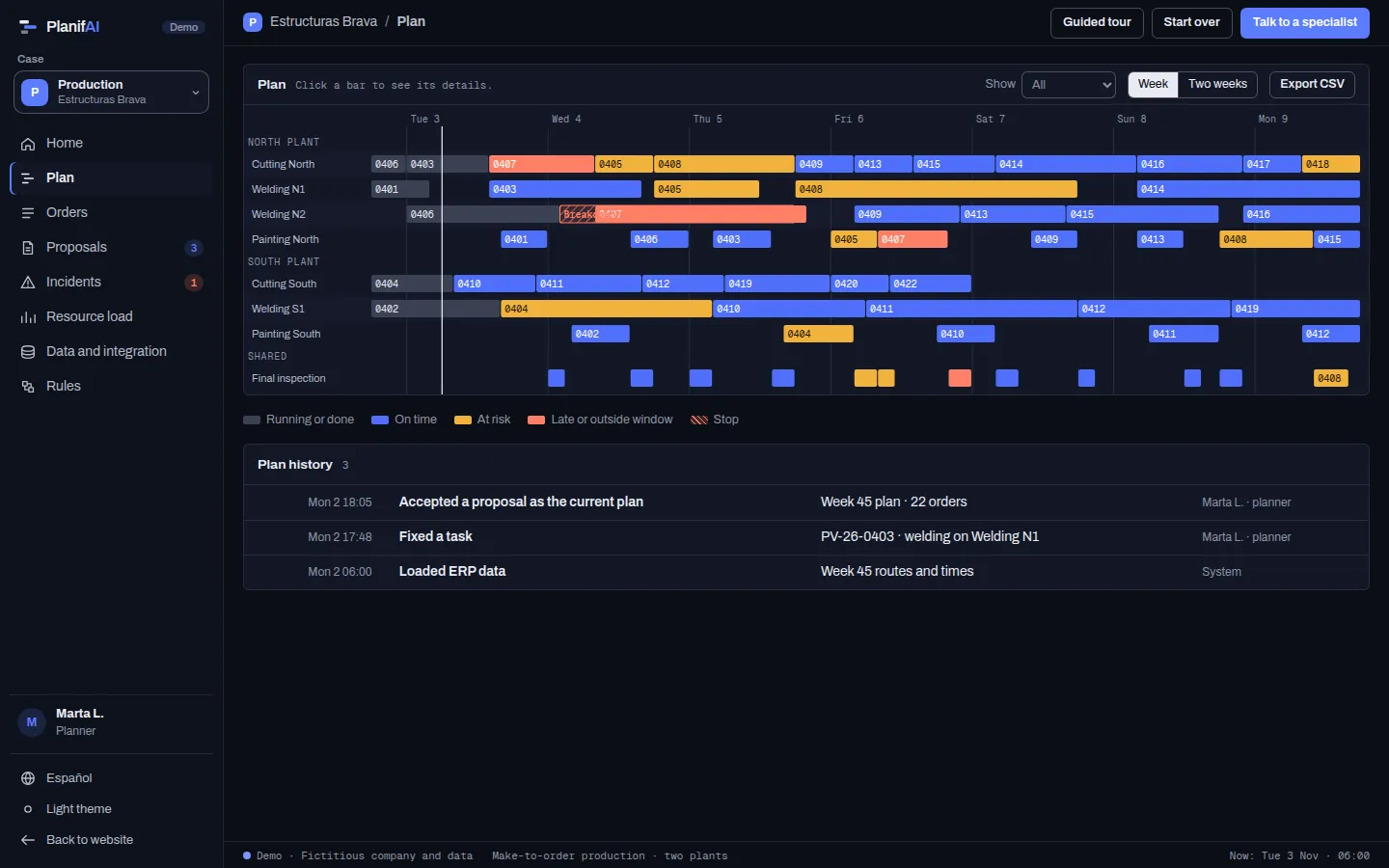
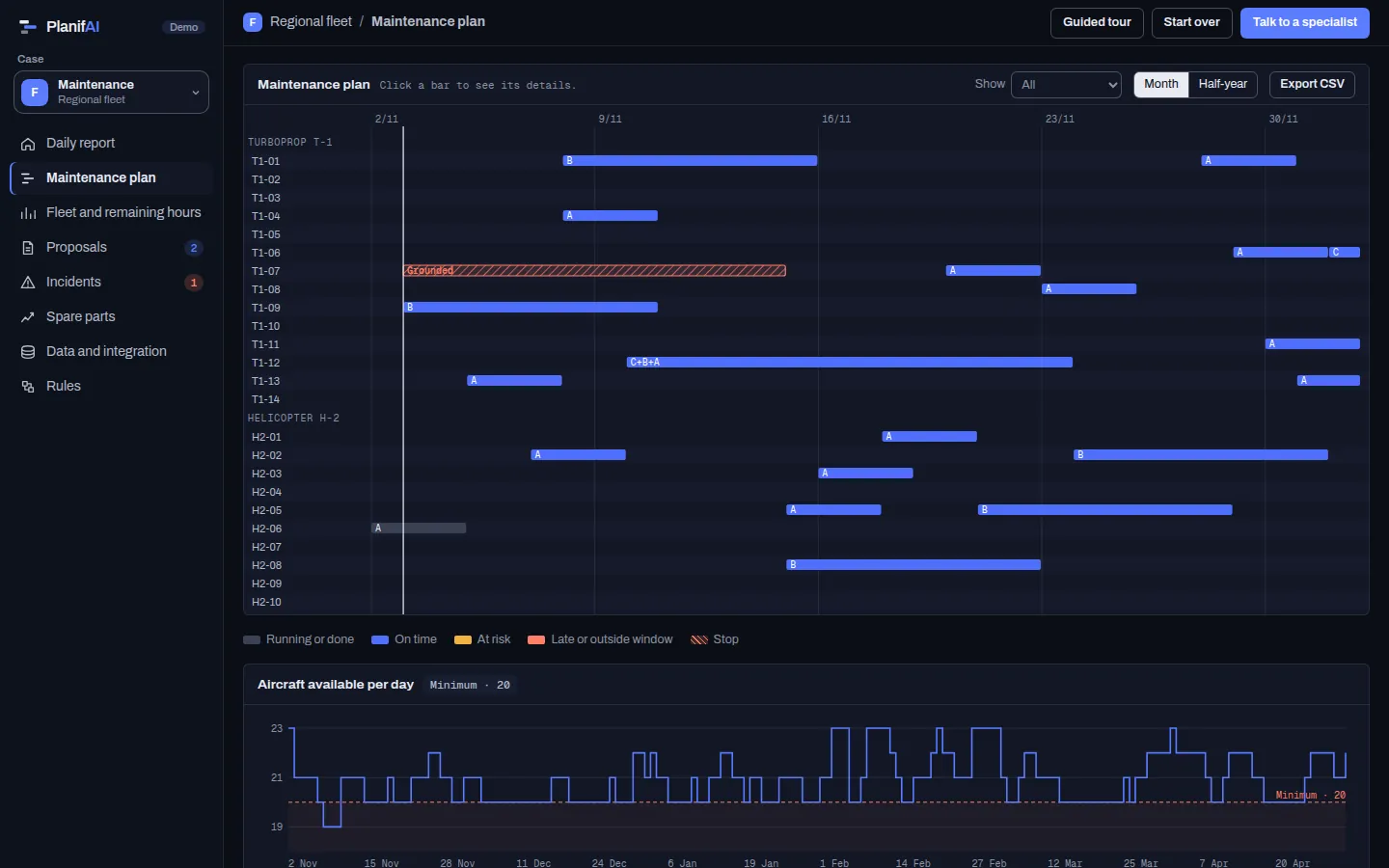
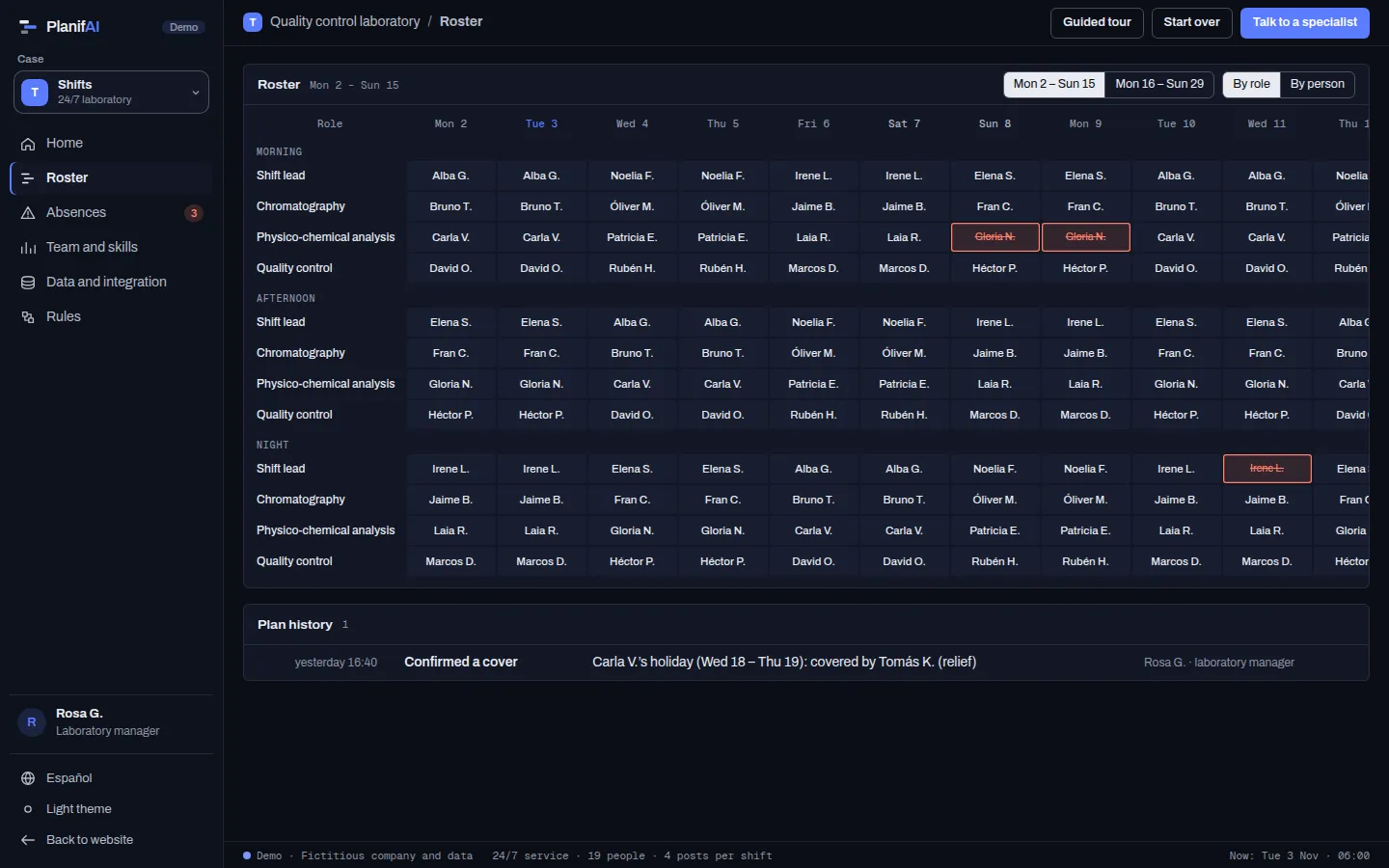
Your industry, your problem
The four solutions combine according to what you decide every day. Find yours.
- Steel and metalsIn what order do heats and coils go through each line, to change as little as possible and still be on time?Steel mills, rolling, galvanising, wire drawing, tubes and sections
- Food and beveragesHow many units of each format do I make tomorrow, on which line and in what order?Sliced bread and bakery, dairy, beverages, ready meals
- Chemicals and batch processesWhich batch goes in each reactor and when, to clean as little as possible and never run out of tank space?Fine chemicals, paints and coatings, cosmetics, pharma
- Automotive and componentsHow do I meet my customers’ sequences without changing tooling every hour?Stamping, injection moulding, machining, component assembly
- Make-to-order structures and equipmentWhat date can I commit to this order without delaying the others?Fabrication, steel structures, machinery, electrical equipment
- Distribution and spare partsWhich of my ERP reorder points fall short and which are filling my warehouse?Industrial distributors, automotive and machinery spare parts, supplies
- Energy, transport and defenceWhen does each asset go in for service so I never run short of the ones I need?Vehicle and aircraft fleets, rolling stock, power plants
- See how it applies in each industry→
Alongside your ERP, not instead of it
Your ERP knows what has to be done. PlanifAI decides when and where it really gets done, and sends back the plan, the reorder point and the safety stock.
- Excel or CSV reviewed before import
- Ingestion from your systems, with quality checks
- An API for your tools
Wherever your data is
The same features in all three options.
- Managed cloudIn the European Union, run by us.
- Your serversYour data centre or private cloud.
- Isolated networkNo internet connection, with the full application.
Frequently asked questions
I already have an ERP (SAP, Oracle, Dynamics…). Why would I need PlanifAI?
The ERP records orders, materials and work orders, and its MRP computes requirements assuming infinite capacity. PlanifAI decides when and where each thing gets done with real capacity and your rules, and lets you compare alternatives before deciding. The ERP stays the system of record.
How does it integrate with my ERP?
We read what your ERP already exports (files, database or API) and send the plan back the same way. There are no packaged connectors: we design the integration with you in the project.
Is the plan really optimal?
In many problems, constraint programming proves that it is. In the largest ones, the evolutionary search returns the best plan it finds in the time you give it, always meeting your hard rules.
Can I buy demand forecasting on its own?
Yes. It is a separate product: buy it on its own or with planning. If you use both, the project defines how the forecast feeds your plans; today the forecast does not change the plan on its own.
How long until it is up and running?
It depends mainly on how complete your master data is (routings, times, calendars) and whether you start with Excel or an automatic integration. We estimate it once we see your data, not before.
How does pricing work?
Annual subscription per scope (one plant, one fleet or one service), implementation separate and a fixed-price pilot. The amount depends on scope; we give it to you after the first conversation.
Why are there no savings figures on this site?
Because they depend on each operation. We measure them with your data during the pilot and show them to you there.
Put it to the test with your data.
We show you the demo on a case like yours. If it fits, a fixed-price pilot compares our plans and forecasts with yours.